
News & Events
April 22, 2026
SuperCDMS SNOLAB reaches target temperature near absolute zero
The Super Cryogenic Dark Matter Search (SuperCDMS) experiment at SNOLAB has reached a significant milestone in the search for dark matter!
The experiment, which recently completed commissioning at SNOLAB, has been cooled to its target temperature of 15 millikelvin, just thousandths of a degree above absolute zero. The operating temperature of SuperCDMS is hundreds of times colder than outer space, making the experiment quite possibly the coldest place in the Universe. The experiment requires this extreme cold to reach a superconductive state. When a particle interacts with the silicon-germanium crystals in the experiment, semiconductors attached to the crystals receive a tiny deposit of energy, which appears as a blip in the computer signal. Researchers interpret the signals to determine what kind of particle caused the blip, hoping to see a unique signature of “light dark matter”.
While many of the experiments at SNOLAB utilize the ultra-low backgrounds provided by the lab’s location, 2km underground. SuperCDMS is unique in it’s approach to additional cryogenic cooling of the experiment.
This milestone is important for the collaboration, who can now begin preparations for data collection.
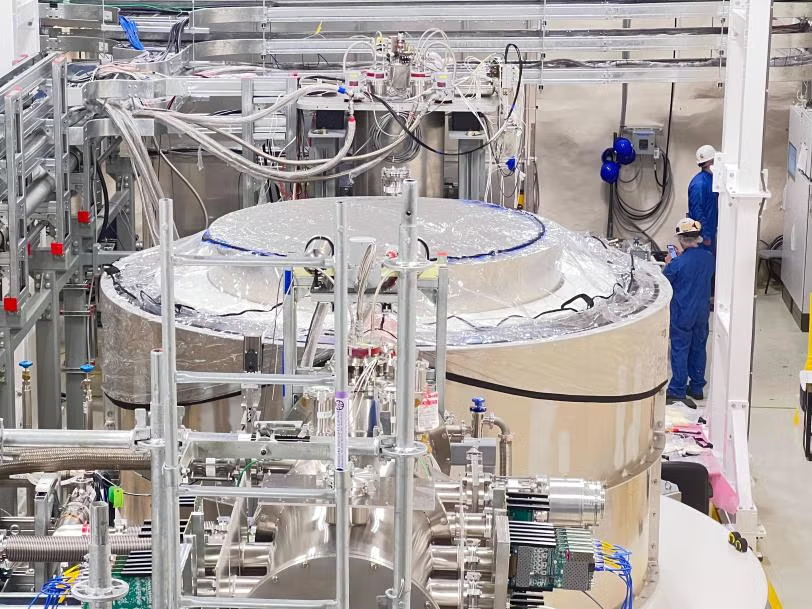
The current set-up of the SuperCDMS dark matter experiment, installed deep underground at SNOLAB in Sudbury, Canada. The detector array sits inside multiple layers of shielding and cryogenic systems designed to keep the sensors extremely cold and protected from background radiation. (SuperCDMS Collaboration)
For more details, read the announcement on the SLAC website.