
News & Events
May 4, 2026
Mixed Reality mural explores Indigenous Knowledge in astroparticle physics
The McDonald Institute, in partnership with the Queen’s University Office of Indigenous Initiatives, the Queen’s Department of Physics, Astronomy and Physics Engineering, and the Agnes Etherington Art Centre, is proud to present the work of artists Will Morin and Quinn ᓂᑳᓐ ᓅᑎᓐ Hopkins.
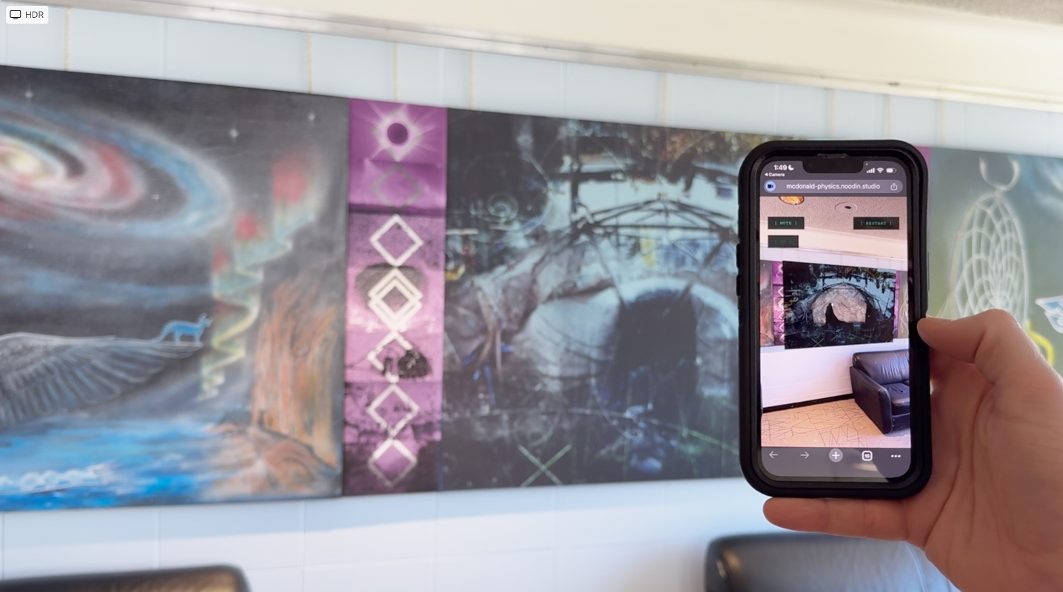
The artwork is presented with a digital AR (Augmented Reality) component. To view the AR, visit mcdonald-physics.noodin.studio/ from a mobile device, or scan the QR code below with a mobile camera app and follow the link on the screen.

If you’re not on a mobile device, you can view the AR sequences in the video below.
Note that the AR experience has audio narration. Please be mindful of others and use headphones to listen.
Will Morin
Morin is of Ojibwa/Scottish and French-Canadian ancestry and is a member of the Michipicoten First Nation. He is an educator and a visual/performance artist living and working in Sudbury.
http://www.artofwillpower.ca
Quinn ᓂᑳᓐ ᓅᑎᓐ Hopkins
Hopkins (Mixed Ojibwe, non-status) is an interdisciplinary artist blending urban Indigenous experiences with digital futurism. His immersive installations and digital artworks explore ancestral storytelling, technological innovation and cultural resurgence.
https://www.instagram.com/noodinstudio/
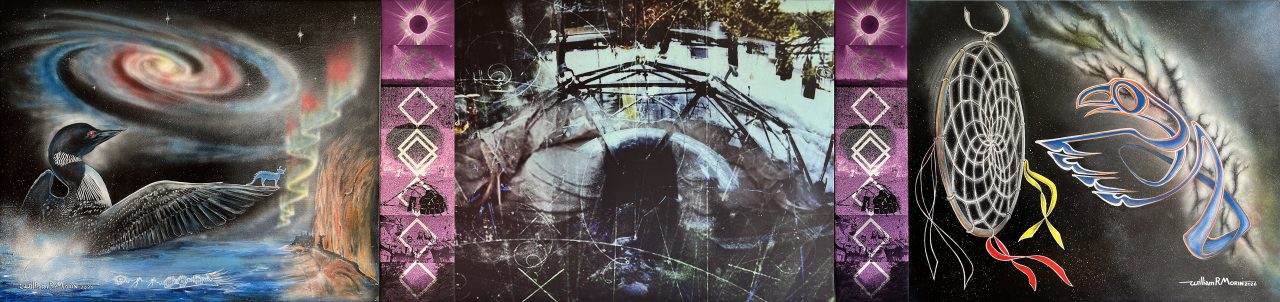
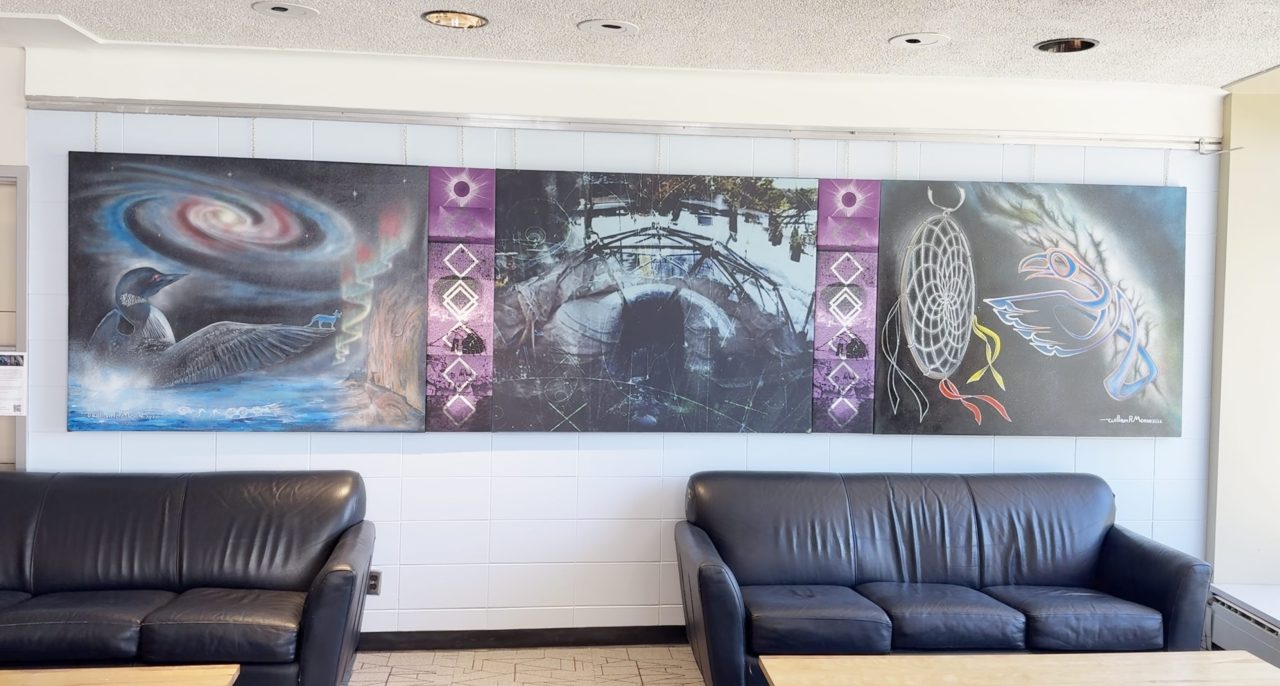
The collaborative artwork, now installed in the 3rd-floor common area of Stirling Hall, spans 18 feet of previously empty wall space. The installation consists of three large, 65-inch-wide panels and two 12-inch-wide panels between them. The two panels on the outside are original paintings by Will Morin, and the other panels are digital prints of imagery by Quinn Hopkins. The panels move from past, present, to future, bringing Anishinaabe knowledge and astroparticle physics into the same frame — a loon rising toward the pictographs of Lake Superior, a lodge layered over SNOLAB two kilometres underground, and a spirit bird travelling the Milky Way alongside a dreamcatcher woven in the same pattern found in pine cones, galaxies, and the spiral of a river.
The title, “Biidaaban,” meaning “dawn comes” or “it is daybreak” in Anishinaabemowin, speaks to the theme of past, present and future in the artwork. The “bii” is used to mean movement forward – coming – the future. The “daa” speaks of: s/he lives, dwells in a certain place – currently: presently. The “ban” is what is added to the names of our deceased, those who have passed on, representing the past.
In addition to the formidable physical artwork, Hopkins has created an AR (Augmented Reality) layer that brings the teachings and physics into motion. Scanning a QR code with a mobile device will present viewers with an interface that uses the device’s camera to locate sections of the mural and activate animated sequences that emerge from the artwork. Audio features the artists’ voices discussing the elements of each panel and how they connect to teachings, understandings, and personal insights about the universe, creation, and the ways humans go about gaining knowledge.
When the McDonald Institute opened a call for artists in the Fall of 2025, it did not require interested artists to have any prior knowledge of physics. Part of the journey would be a Two-Eyed Seeing, Knowledge Sharing Circle, where Indigenous Elders and Knowledge Keepers would come together with physicists to explore the questions that have been asked for thousands of years. Where do we come from? What is the nature of matter? And how can we figure it all out? Morin and Hopkins heard a common thread running through the conversations and present this artwork as a response, a prompt to those who wonder: to see with two eyes open – to connect with the land, the animals, the sky, and learn about Indigenous stories and languages, and bring that perspective into the practice of theorizing, calculating, and designing experiments. The artists hope that the artwork can help inspire continued two-eyed seeing, learning, and teaching of physics at Queen’s and in Canada.
Public reception and artist talks
The McDonald Institute is hosting a public unveiling event featuring talks by the artists and special guests from the project organizing committee in the 3rd Floor Student Lounge of Stirling Hall on July 27th. A catered reception will begin at 5:30 PM, followed by talks starting at 6:15.