
Education Hub
The Models
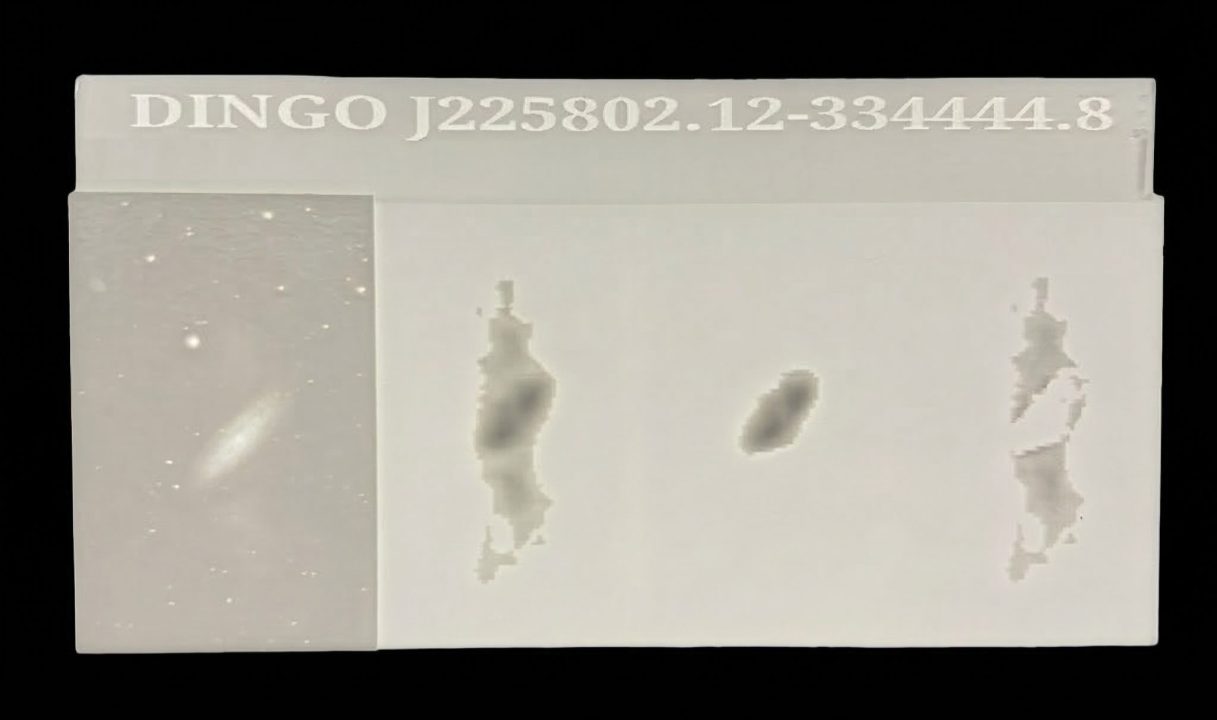
Galaxy Lithophane Models
The Galaxy Lithophane models are three-dimensional prints generated from astronomical imagery and radio astronomy surveys that use variations in thickness to produce detailed images when illuminated from behind. When backlit, the lithophane reveals high-contrast visual representations of galaxy structure, highlighting spiral arms, central bulges, and variations in brightness. This approach transforms astronomical images into physical objects that preserve scientific detail while introducing a new, interactive dimension to visual exploration.
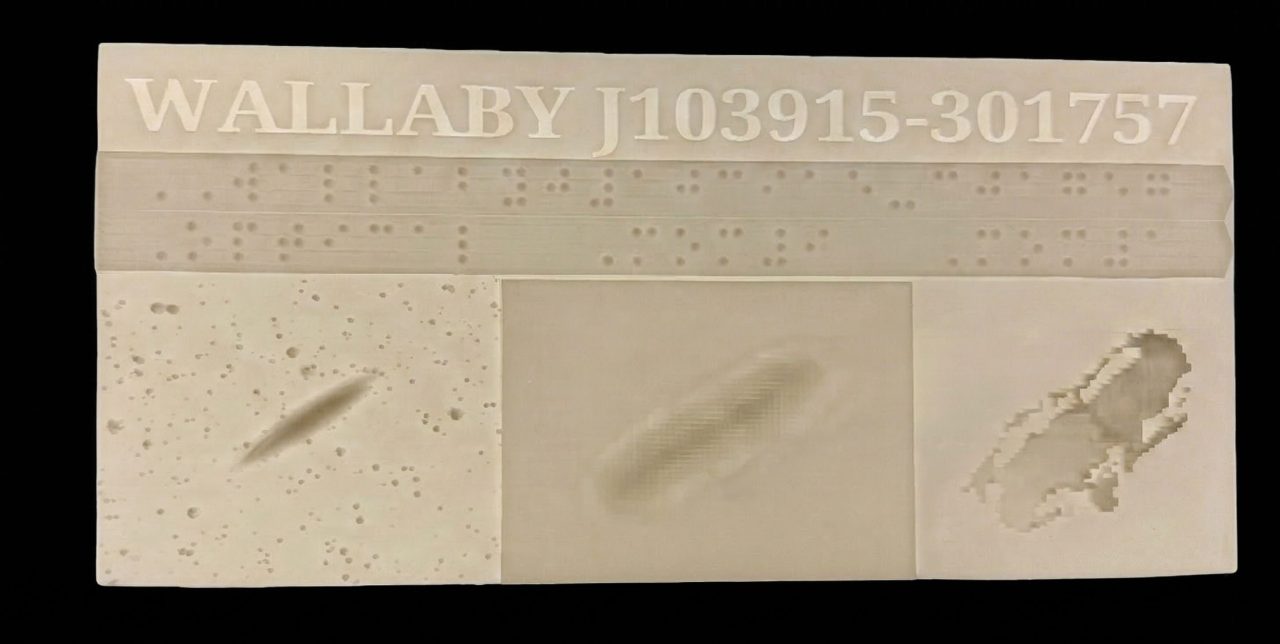
In addition to their visual impact, these models are designed to support tactile learning. Surface contours and raised structural elements allow learners to trace spiral patterns and identify core features through touch. Braille labeling and tactile legends can be incorporated to provide accessible descriptions and orientation cues, enabling use by learners who are blind or have low vision. By combining illuminated visual detail with tactile features, the lithophane models strengthen multi-sensory engagement in educational environments. For educators and researchers, they offer a flexible tool that supports inclusive science communication, reinforces structural understanding of galaxies, and demonstrates how astronomical data can be adapted to broaden participation in physics learning.
3D Tactile Galaxy Models from Radio Data
The three-dimensional galaxy models are generated from radio telescope survey data using a modified version of the Astro3D modelling pipeline. These models translate observational datasets — including spatial structure and gas distribution — into fully volumetric physical representations of galaxies. By converting radio survey data into layered, printable geometry, the models provide a spatially accurate depiction of galaxy structure that extends beyond two-dimensional imagery.
Unlike flat visualizations or moment maps, these full 3D prints allow learners to examine thickness, asymmetry, and structural variation from multiple angles. Spiral features, warps, and gas distributions can be observed visually and explored tactually, enabling users to physically trace structure and compare different galaxy morphologies. For educators, the models provide a powerful tool for teaching spatial reasoning and data interpretation, particularly when introducing how astronomers reconstruct three-dimensional structure from observational data. By combining scientific accuracy with interactive design, these models bridge computational astrophysics and hands-on learning in both classroom and outreach settings.
Dark Matter Halo
The Dark Matter Halo model is a three-dimensional representation of the extended, invisible structure that surrounds and influences galaxies. While dark matter cannot be directly observed, its presence is inferred through gravitational effects on visible matter, gas, and galaxy rotation. This model makes that inferred structure tangible by physically illustrating the halo’s scale, shape, and relationship to the luminous disk. By presenting the halo as an encompassing structure rather than a central mass, the model clarifies how dark matter extends well beyond the visible boundaries of a galaxy.
Designed as an interactive display, the model can be rotated to demonstrate the dynamic relationship between the galaxy and its surrounding halo. This rotational feature supports discussion of galaxy motion and the evidence provided by rotation curves, helping learners visualize why outer regions of galaxies move differently than expected from visible matter alone. For educators, the model provides a compact visualization tool that strengthens explanations of galaxy dynamics and mass distribution. By combining spatial structure with physical interaction, it reinforces how astronomers infer unseen mass and why dark matter remains one of the central challenges in contemporary astrophysics.
DEAP-3600 Dark Matter Detector
The DEAP-3600 Detector model is a 1/11 scaled physical representation of the DEAP-3600 Dark Matter Detector located at SNOLAB. Developed to support Visitor Centre programming and public engagement initiatives, the model translates the large-scale underground experiment into a tangible, three-dimensional format. It captures the detector’s spherical geometry, inner target volume, photomultiplier tube arrangement, and surrounding shielding structure, offering spatial clarity that is difficult to achieve through two-dimensional schematics or photographs alone.
A key feature of the model is its spliced, cutaway design, which allows internal components to be viewed and examined directly. This sectional perspective enables educators and researchers to explain detector architecture, containment systems, and light-collection mechanisms in a clear and intuitive way. By making internal structure visible and physically accessible, the model supports more effective communication of how rare particle interactions are measured and why detector geometry and shielding are critical in dark matter searches. In both outreach and academic contexts, the model serves as a compact visualization tool that reinforces experimental design principles while strengthening connections between fundamental research and public understanding.
The Standard Model of Particle Physics
The Standard Model of Particle Physics 3D model is a modular, physical representation of the fundamental particles and force carriers that make up the universe. Based on a conceptual “periodic table” of elementary particles — including quarks, leptons, gauge bosons, and the Higgs boson — this model translates abstract particle physics into tangible components that can be held, examined, and discussed. The physical pieces correspond to each particle type, allowing learners to explore key properties such as charge, spin, and mass in a hands-on format.
For educators, this model offers a compelling way to introduce the Standard Model beyond static diagrams, aiding conceptual understanding by engaging learners physically as well as visually. By handling and comparing individual particles, students can build intuition about how matter and forces are classified and related within the Standard Model framework — a foundational theory in modern physics that explains three of the four fundamental forces and the behavior of known subatomic particles. In research-adjacent contexts, the model serves as a teaching tool that bridges formal theory with accessible representation, reinforcing discussions on particle interactions, symmetry, and the ongoing search for physics beyond the Standard Model.
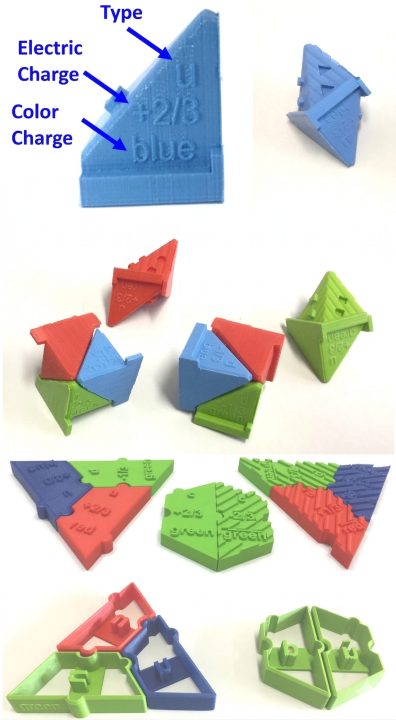
Quark Puzzle
The Quark Puzzle model is a hands-on representation of the fundamental building blocks of matter inspired by educational resources developed by CERN. This interactive model breaks down protons, neutrons, and other composite particles into their constituent quarks — up, down, strange, charm, top, and bottom — and allows learners to assemble and disassemble particle configurations. By physically manipulating the quark pieces, learners can explore how larger particles are constructed and how the combinations of quarks determine properties such as charge and particle type.
The Quark Puzzle model provides a concrete way to introduce the Standard Model’s quark structure in classrooms and outreach settings. Abstract particle physics concepts can be difficult to visualize, especially for learners encountering them for the first time; tangible, interactive components help demystify these ideas and support experiential learning. Through guided exploration with the Quark Puzzle, learners deepen their grasp of fundamental matter, making complex concepts more accessible and memorable.