
Beading Astroparticle Physics
A new collaboration is taking shape, bringing Indigenous Knowledges and Perspectives and astroparticle physics into conversation.
The McDonald Institute is celebrating the launch of the Beading Astroparticle Physics project, an initiative that brings Indigenous Knowledges and Perspectives (IKP) and astroparticle physics into conversation with each other. Grounded in Indigenous leadership and relational ethics, the project reimagines how astroparticle physics can explore, understand, and relate to the universe.
Led by Dr. Danielle Lussier, the project includes Dr. Gregg Wade and three junior collaborators [Hugo (age 14), Rosie (age 13), and Opale (age 9)] as an intergenerational team exploring astroparticle physics through Métis beadwork practices. Beadwork is often a shared, intergenerational family practice in many Indigenous communities, serving as a site of teaching, relationship-building, and cultural continuity (Ansloos et al. 2022; Lussier 2022). Beading is a collective Indigenous research method of cultural expression, storytelling, healing, and knowledge mobilization (Lussier 2021, Prete 2019). Beading Astroparticle Physics enacts a decolonizing approach to knowledge creation, centering family and community, relationality, and multiple ways of knowing in partnership with Western science.
Over the coming year, the team will engage with members of the Canadian astroparticle physics network in a shared exploration of astrophysical research concepts through beadwork practices that reflect the relationships that make science possible, including relationships between humans, more-than-human worlds, creative practices, and scientific inquiry. Through research exchanges, site visits, workshops, and community engagement activities, the project will support the creation of novel research and original beadwork grounded in both scientific and cultural narratives. Tangible outcomes will include beadwork pieces displayed in the McDonald Institute Visitors Centre (Stirling Hall), a workshop on beadwork and astroparticle physics at the Annual National Meeting (July 27-29, 2026), public and academic knowledge mobilization, and teaching materials, including education and outreach programming for grade 6 students, co-created by the McDonald Institute’s first Indigenous – Cross Disciplinary Intern (I-CDI), also collaborating on the project.
By bringing together Indigenous Knowledge systems, artistic practice, and astroparticle physics, Beading Astroparticle Physics contributes to a broader reimagining of research, education, and public engagement within the national astroparticle physics community. The project reflects the McDonald Institute’s ongoing commitment to meaningful engagement with Indigenous scholars, students, communities and ways of knowing.

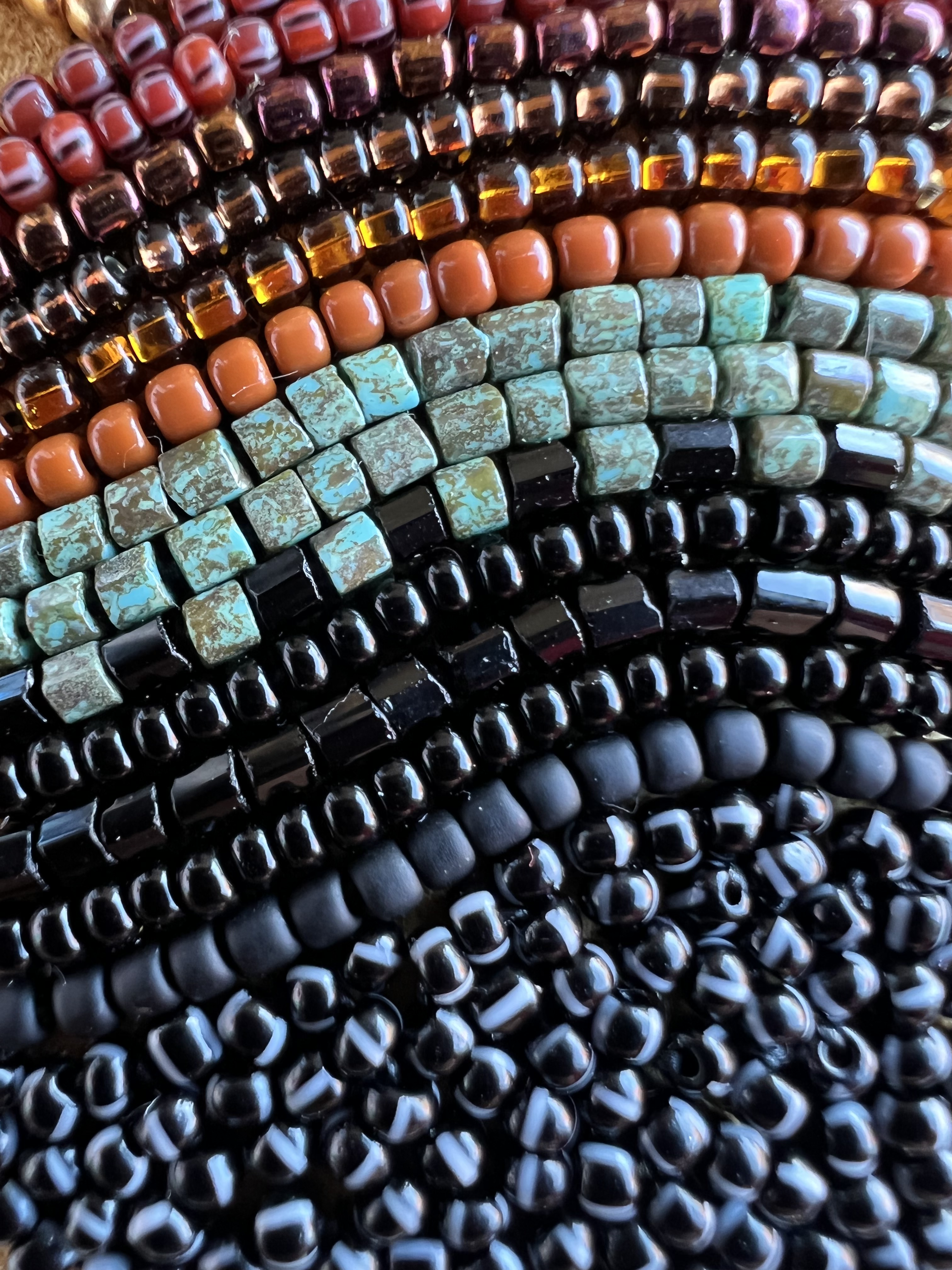
Beadwork by Danielle Lussier. Photo supplied by Danielle Lussier.
Project Team Leadership
Dr. Lussier is a Red River Métis scholar, beadwork artist, and nationally recognized leader in Indigenous education. She is the Queen’s National Scholar and Chair in Indigenous Knowledges and Perspectives in the Department of Languages, Literatures, and Cultures. Her work brings together Indigenous legal orders, decolonial methodologies, and beadwork as a form of knowledge creation, reshaping how knowledge is taught and understood in post-secondary education. Dr. Wade is an internationally recognized astrophysicist whose research focuses on the structure and evolution of magnetic fields in stars, and whose work has contributed to major international collaborations in stellar physics. He is based at the Royal Military College and cross-appointed with Queen’s University.
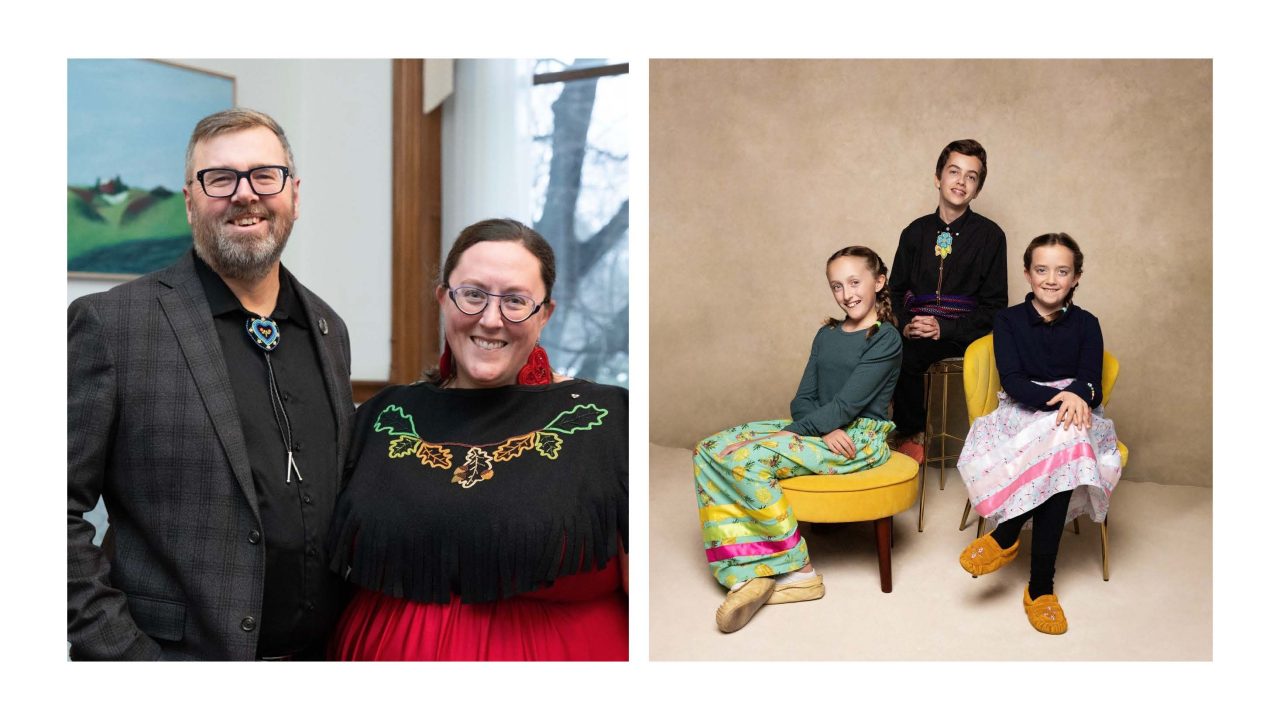
Dr. Gregg Wade, Dr. Danielle Lussier, and junior collaborators Rosie, Hugo, and Opale lead the Beading Astroparticle Physics project.
Hugo Lussier-Meek is an eighth-grade citizen of the Manitoba Métis Federation and a Michif language learner. He is a beadworker who, in 2026, completed Creative Futures a professional development program co-facilitated by the Agnes Etherington Art Centre, Cultivate Art Commons, and the Tett Centre for Creativity & Learning that offered a unique opportunity for teens to explore their artistic voice, grow their skills, and connect with a community of peers.
Rosalie Lussier-Meek is a citizen of the Manitoba Métis Federation and a seventh-grade learner. Her artistic practices range from beadwork and embroidery to watercolour and creative writing. Her short story Barry and Endgame’s Grocery Store Adventure was published in One Story a Day by Kids for Kids 2024 (DC Canada Education Publishing). She and her brother are alumni of IDEAS Camp (2024) offered by the Queen’s Department of Physics, Engineering Physics, and Astronomy in collaboration with the McDonald Institute and SNOLAB, and they also recently completed Science Literacy week’s Research Spanning from Sea to Space (2025) and the IceCube Masterclass for High School & Early Undergrad Students (2026).
Opale Lussier-Meek is a citizen of the Manitoba Métis Federation and an elementary school learner. She is an enthusiastic citizen scientist, who, along with her siblings, has contributed to land-based education offerings and beading workshops across Kingston. In the winter of 2026, alongside her brother and sister, delivered a guest lecture on her beadwork practice in one of her mum’s classes!
The involvement of the three junior collaborators is central to the project and reflects the importance of intergenerational knowledge-sharing, where beadwork is practiced, learned, and carried forward within families. They became interested in astroparticle physics as a family; participating in several education and outreach events that inspired them to consider approaching the field through beadwork. Together, their research explores beadwork as a method of storytelling, research, and relational learning, creating space for Indigenous Knowledges and Perspectives to engage with scientific understandings of the universe.
Why Beadwork and Astroparticle Physics?
This project is important to astroparticle physics because it broadens the ways the field engages with knowledge, moving beyond purely technical approaches to include relational, creative, and community-based ways of understanding the universe. By bringing Indigenous knowledge systems, particularly Métis knowledge, into dialogue with astroparticle physics, the project challenges researchers to think differently about observation, interpretation, and responsibility.
Beadwork can be understood as a form of Indigenous science because it is grounded in systems of knowledge that are observational, relational, and iterative. Recent scholarship has also demonstrated how beadwork can support teaching and understanding of complex mathematical concepts, highlighting the potential for this practice to provide a bridge between Indigenous Knowledges and Perspectives with STEM disciplines (see Plosker and Mattes, 2025). Through beadwork, practitioners engage with pattern, symmetry (and balanced asymmetry), counting, spatial reasoning, and material properties, while also drawing on teachings about land, seasons, and relationships with the more-than-human world. Designs are not arbitrary; they encode stories, laws, and ways of understanding the universe, developed and refined over generations through careful practice and knowledge transmission. As a research-creation practice, beadwork brings together empirical attention to detail with cultural meaning and responsibility, demonstrating that science is not limited to laboratories, but can also be carried through artistic, embodied, and community-based forms of knowing.
Beadwork also plays a critical role in knowledge mobilization. Through beadwork, storytelling, and youth-focused learning materials, complex concepts in astroparticle physics become more accessible and meaningful to broader audiences, especially young learners who may not otherwise see themselves reflected in the field. In doing so, the project contributes to more inclusive pathways into science. Finally, the work introduces a model of reciprocity that is often absent in scientific practice. By embedding research in relationships, with communities, with learners, and with the more-than-human world, the project invites astroparticle physicists to consider not only what they know about the universe, but how that knowledge is constructed, shared, and held responsibly.
Project Beginnings and Development
To kick off the project, the family hosted Dr. Arthur B. McDonald (Professor Emeritus and Nobel Laureate) for a dinner conversation of astroparticle physics, creating space for shared learning grounded in relationship and exchange. The setting reflected the project’s emphasis on relational approaches to knowledge, where dialogue unfolds through connection, curiosity, and mutual respect.
Dr. McDonald commented: “It was a joy to interact with this dynamic family over a delicious meal. It took me back to our family dinner table with our own four kids many years ago. I had great conversations with the kids about the science we are studying and hope that it inspired their creative beadwork. I love to see “other ways of knowing” about our subject area. The game of UNO was a wonderful and fun way to get to know each other. I hope someday to be as good at it as Opale!”
Guided by the family’s Indigenous research leadership, these early conversations and interactions are shaping the direction of the project, including how scientific ideas are approached, interpreted, and expressed through Métis beadwork practices.
The project team shared conversations with Dr. Joe Bramante, Dr. Aaron Vincent, and Dr. Nahee Park at Queen’s University to engage with theories and experiments related to dark matter and high-energy neutrino astrophysics. Each faculty member reflected on their role in advancing particle astrophysics research, highlighting how their work relies on the Earth’s elements (water, ice, air, and land) to enable scientific discovery. The Lussier family also drew attention to the more-than-human world that underpins this research, noting a perceived absence of reciprocal relationships in current scientific practices. These exchanges are not only informing the scientific context of the project, but are being interpreted through the family’s beadwork practice, where meanings emerge through Indigenous Knowledges and Perspectives.
Dr. Bramante reflected “hearing from Danielle about her story as a professor at Queen’s, and her family’s connection to beadwork as a way to understand and record knowledge, reminded me of my research group’s work using ancient rocks, mica in particular, to look for dark matter. A mica crystal may carry a record of dark matter stretching back hundreds of millions of years; in that sense the rock would be a detector, holding onto something laid down long before we arrived to read it. To me it seemed that both beadwork and ancient minerals are ways of holding a record of something larger over long stretches of time. Our conversation left me thinking about mica as something the beadwork project asks us to be in relationship with.”
Dr. Vincent noted that “we are seeing a significant decline in Indigenous engagement with physics, and science more broadly, particularly at the graduate level [at Queen’s]. Being able to foster that kind of engagement—whether with people across the university or with young people considering a future in science—is incredibly valuable. For me, the value of the Beading Astroparticle Physics project is in exploring perspectives beyond the traditional Western scientific framework and recognizing how culture influences the way people engage with science and academia. What really stood out to me was seeing that Métis beadwork is not just art; beadwork is also a means of cultural and historical knowledge transfer. The beadwork as a language especially resonated with me because language shapes your perception and the way you think about things. Experiences like this remind me that knowledge is communicated in many ways, and that language, art, history, and culture all play important roles in how we understand and make meaning of the world.”
Dr. Park reflected on how engaging with the beadwork team broadened her understanding of knowledge sharing and the value of different worldviews: “One of the things that continues to stand out to me is how different worldviews can enrich our understanding of the world. In physics, we often focus on very specific questions, while Indigenous scholars may begin by asking about how nature is connected to the work. I found that perspective refreshing and valuable because it broadens how we think about knowledge. Our goal is often to share scientific knowledge, but that does not mean we should dictate how others receive or understand it. What I appreciated most was the exchange of perspectives; we extend their view, and they extend ours. That mutual learning was one of the most meaningful aspects of the experience.”
While conversations are essential in laying the groundwork for the project, so too are opportunities to encounter the science firsthand. An early stage of this work recently took place in Sudbury, where the Lussier–Wade family travelled to visit partners at the surface facilities of SNOLAB. Conversations facilitated by Dr. Erica Caden (Senior Research Scientist) and Blaire Flynn (Senior Education and Outreach Officer) emphasized the functions of the lab, the layers of people involved in the experiments and facility, as well as the more than human interactions involved. This visit created space for shared learning and exchange, connecting the environments of astroparticle physics with the project team’s evolving knowledge of the astroparticle physics research ecosystem.
“During the family’s visit to SNOLAB, we brought together a group of scientists and technologists whose work centered around the natural elements as well as some chemical ones: Copper, Radon, Nitrogen”, said Dr. Caden. “We were very pleased for the opportunity to share our research experiences with the Lussier-Wade family; to talk about our work in using and measuring those elements; and to explain how we use particle physics to better understand the land, the air, the sun, and the stars. The junior collaborators had very thought-out questions about our work, and we shared with them bracelets made from copper that was reclaimed after cleaning parts for an underground experiment. We are looking forward to see how the concepts are translated into the beading medium!“
This visit created space for shared learning and exchange, connecting the environments of astroparticle physics with the project team’s evolving knowledge of the astroparticle physics research ecosystem.
“It was wonderful to learn from and alongside the Lussier-Wade family during their visit to SNOLAB and Laurentian University” noted Blaire Flynn. “The opportunity to consider our work through the lens of relationality and to think about reciprocity in our research was valuable and is something that I’m still sitting with. I’m so looking forward to seeing this project develop and to continue learning together.”
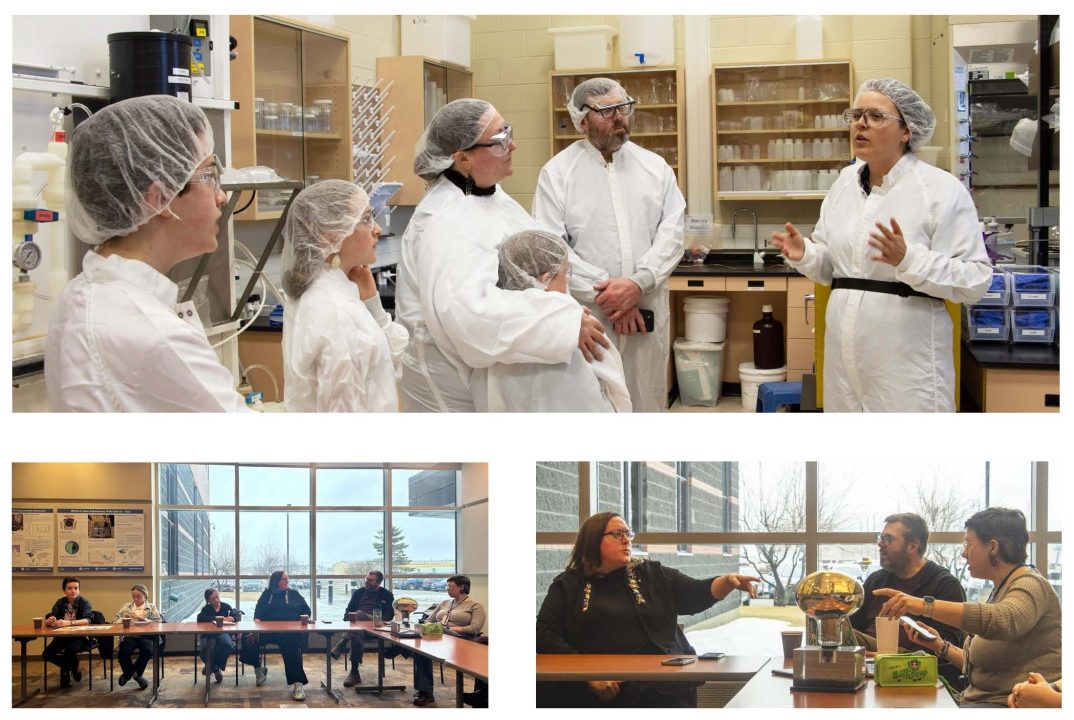
Top Image: The Beading Team participating in a surface lab tour by Sharayah Read, Chemical Technologist. Photo Credit: Glede Zhang. Bottom Left: Hugo, Rosie, Opale, Dr. Danielle Lussier, Dr. Gregg Wade, and Dr. Erica Caden at SNOLAB, Sudbury. Photo Credit: Alex Pedersen. Bottom Right: Dr. Lussier points to a detector bulb, in conversation with Dr. Wade and Dr. Caden at SNOLAB. Photo credit: Glede Zhang.
“It was exciting to get dressed in clean suits to visit the lab”, said Opale. “It was like being a marshmallow!”
Hugo commented: “I really appreciated visiting SNOLAB. It helped me to better understand the science that the project is working to translate.”
“My favourite part of our work so far has been the chance to meet with the different scientists and hear about the work they do. I’m looking forward to inviting them to bead at the National Meeting!”: Rosie, age 13.
![[Left-Right: Hugo, Rosie, Opale in the SNOLAB surface clean lab space. Photo credit: Danielle Lussier]](https://mcdonaldinstitute.ca/wp-content/uploads/2026/06/Beading_APP_Junior_Collab_Triptic_June2026-1280x720.jpg)
Left-Right: Hugo, Rosie, Opale in full PPE at the SNOLAB surface clean lab. Photo credit: Danielle Lussier.
During their time in Sudbury, the team also spent time with Will Morin, a local artist and Ojibway Knowledge Holder, who shared stories and teachings that deepened connections between Métis and Anishinaabe perspectives. These exchanges tied the visit together through relationship building, place-based knowledge, and ethical responsibility. Morin was kind enough to lead a presentation on sky stories with Laurentian University’s Dorian Planetarium Director, Dr. Hoi Cheu, for the project team, as well as SNOLAB staff and Laurentian employees participating. The family was met by staff at Laurentian’s Indigenous Sharing and Learning Centre, to highlight connections to local peoples and cultures and learn about successes in Indigenous student supports. Together, these experiences supported reflection, dialogue, and the development of new ideas; insights that will continue to shape the beadwork and the relationships at the heart of the project.
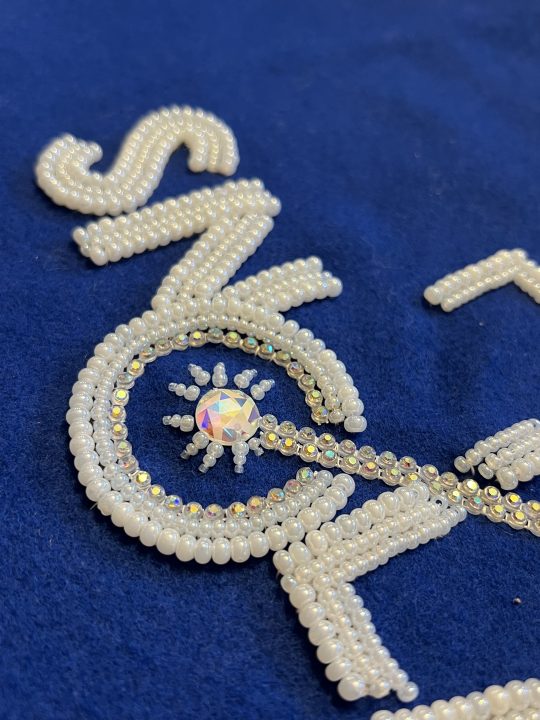
Beading Astroparticle Physics sneak peek of the SNOLAB logo in production. Photo by Danielle Lussier.
What's Yet to Come
This project will continue to unfold over the coming year through discussions and observations with astroparticle physicists, research activities, beadwork creation, and opportunities for community engagement and knowledge mobilization. The first McDonald Institute Indigenous-Cross-Disciplinary Intern (I-CDI), PhD candidate Liv Rondeau, will take up research this summer with the Beading Astroparticle Physics team. Rondeau is a scholar and artist of Kanyen’kehá:ka, Irish, and French Canadian heritage, brings a Haudenosaunee, community-grounded perspective to the project. Her work draws on Haudenosaunee knowledge systems, including sky knowledge, and is rooted in ongoing relationships with Kenhté:ke. Working alongside Dr. Lussier and Dr. Wade, Rondeau will contribute a research-creation approach centred on Haudenosaunee raised beadwork as embodied knowledge. This work will support the development of youth-focused learning materials, including beadwork, lesson plans, and interpretive resources, designed for students in the Limestone District School Board and be expanded to other classrooms in the future. The Beading Astroparticle Physics project is rooted in ongoing relationships. Over the course of the project, the team hopes to establish and nurture relationships with esteemed community-based astronomical knowledge holders to ensure the work is appropriate, authentic, and grounded in Indigenous ways of knowing.
![[Liv Rondeau, PhD candidate in Cultural Studies at Queen’s University, McDonald Institute Indigenous-Cross Disciplinary Intern, 2026]](https://mcdonaldinstitute.ca/wp-content/uploads/2026/06/Rondeau_Liv_Article_June2026-720x720.jpeg)
Liv Rondeau, PhD candidate in Cultural Studies at Queen’s University, McDonald Institute Indigenous-Cross Disciplinary Intern, 2026.
A centerpiece of the Beading Astroparticle Physics Project will be a hands-on workshop hosted at the McDonald Institute’s 2026 Annual National Meeting (July 26–28, 2026). Bringing together physicists, students, staff, and community members from across Canada’s astroparticle physics community, the workshop will invite participants to engage directly with Métis beadwork as a method of reflection, storytelling, and knowledge creation. Through the process of beading their own research, participants will explore new ways of thinking about scientific practice, relational modes of knowledge generation, and the connections between Indigenous Knowledges and Perspectives and astroparticle physics.
More information will be shared as the project continues to grow – stay tuned!
This initiative is directly supported by the Arthur B. McDonald Canadian Astroparticle Physics Research Institute in collaboration with the Office of Indigenous Initiatives, the Agnes Etherington Art Centre at Queen’s University and SNOLAB. We acknowledge NSERC for the funds contributed through the McDonald Institute for this work.
Works Cited
Ansloos, Jeffery, Ashley Caranto Morford, Nicole Santos Dunn, Lindsay DuPré, Riley Kucheran. (2022). Beading Native Twitter: Indigenous arts-based approaches to healing and resurgence. The Arts in Psychotherapy, Volume 79, 2022: 101914. https://doi.org/10.1016/j.aip.2022.101914.
Lussier, Danielle. (2021). Law with Heart and Beadwork: Decolonizing Legal Education, Developing Indigenous Legal Pedagogy, and Healing Community. PhD diss., University of Ottawa.
— (2022). “What Do You Call an Indigenous Woman with a PhD in Law? Resisting the Subjugation of Indigenous Expertise in Legal Spheres,” Canadian Journal of Women and the Law 34, no. 1 (2022): 109–145. https://doi.org/10.3138/cjwl.34.1.04
Prete, Tiffany Dionne. (2019). Beadworking as an Indigenous Research Paradigm. Art / Research / International: /A/ Transdisciplinary / Journal, 4(1), 28–57. https://doi.org/10.18432/ari29419
Plosker, Sarah., and Mattes, Cathy. (2025). Indigenous Beadwork as a Method of Teaching Linear Algebra. Native American and Indigenous Studies 12(2), 116-135. https://dx.doi.org/10.1353/nai.2025.a971973.