
Jobs & Opportunities
The Arthur B. McDonald Canadian Astroparticle Physics Research Institute (McDonald Institute) is committed to inclusive excellence in research for the benefit of Canadians. At the McDonald Institute, we recognize that achieving a more equitable, diverse and inclusive research network is essential to the creation of rigorous, innovative and impactful research necessary to collectively tackle the frontier questions in astroparticle physics. The recruitment efforts of our personnel are reflective of our desire to further strengthen our network by actively seeking diversity of skills, identities, experiences, and perspectives. We welcome and strongly encourage applications from candidates who will contribute to the further diversification of the McDonald Institute network. Come work with us to further uncover the secrets of our universe. Accommodations for job applicants with disabilities are available on request.
Here we endeavour to post any jobs & opportunities from across the Canadian astroparticle physics community. If you have an opportunity open in your research group, please email a pdf or a link with details about the posting to admin@mcdonaldinstitute.ca so that we can post it here.
HIDDEN - NOTES - Please Read Before Posting!
Include the following details for positions posted here:
Job Title (Level of position, and specific role)
Institution (and optionally, the department)
Supervisor: Alex Wright
Length of position:
Date Posted:
Deadline for full consideration:
HIDDEN - Executive and Senior Research Positions
Manager, Scientific and Physical Infrastructure
McGill University: Experimental Particle Physics Group – XLZD Collaboration
McGill University’s experimental particle physics group is seeking a Manager, Scientific and Physical Infrastructure to support and grow into a system‑level technical leadership role for infrastructure supporting the XLZD experiment, a next‑generation astroparticle physics project. The successful candidate will lead technical studies, contribute to requirements definition and interface management, and support the oversight of external engineering services, translating scientific objectives into robust, cost‑effective infrastructure solutions in collaboration with senior project leadership. This role is well suited to an engineer with approximately 5–7 years of experience who is ready to take the next step toward system‑level technical leadership; more experienced candidates with a strong interest in scientific infrastructure are also encouraged to apply.
Deadline for full consideration: 2026-07-12
Supervisor: Thomas Brunner
Length of position: One-year contract with the possibility of renewal.
Scientific Director
Arthur B. McDonald Canadian Astroparticle Physics Research Institute
The Scientific Director guides strategic planning, champions major initiatives, and ensures alignment with federal research priorities, funding agencies, and international scientific efforts. They foster an inclusive, collaborative research culture, mentor emerging scientific talent, and promote interdisciplinary connections across cosmology, particle physics, and underground science. As the Institute’s chief scientific ambassador, the Scientific Director represents the McDonald Institute nationally and internationally, strengthens partnerships, elevates the profile of Canadian discovery science, and supports the Institute’s commitment to training, outreach, and public engagement.
Applications are being reviewed as they are received, and the position will remain open until filled.
HIDDEN - Administrative Positions
Education & Curriculum Lead
McDonald Institute, Education and Outreach Office
Supervisor: Mark Richardson
Length of position: 12 months
Date Posted: May 14, 2026
Deadline for full consideration: June 2, 2026
Working closely with the Education and Outreach Officer, the Education & Curriculum Lead will act as a teacher-in-residence at the McDonald Institute and will be responsible for bringing a teacher’s classroom perspective and curriculum-informed pedagogical approach to our education and outreach portfolio.
Position Details
HIDDEN - Faculty Positions
HIDDEN - Postdoctoral Opportunities
Postdoctoral Fellow in Quantum Sensing for Experimental Nuclear and Neutrino Physics
Queen’s University, Quantum Sensing for Subatomic Physics (QSSP) program
Supervisor: Prof. Kyle Leach
Length of position: Two (2) years (with the possibility of renewal)
Date posted: May 25th, 2026
Deadline for full consideration: July 30, 2026
Position Details
Postdoctoral Fellow in experimental neutrino physics
Queen’s University, SNO+ Group
Supervisor: Prof. Mark Chen
Length of position: Two (2) years (with the possibility of renewal)
Date posted: April 16, 2026
Deadline for full consideration: April 24, 2026
Position Details
Postdoctoral Fellow in experimental astroparticle physics
University of Toronto, SuperCDMS Group
Supervisor: Prof. Miriam Diamond
Length of position: Two (2) years (with the possibility of renewal)
Date posted: April 8, 2026
Deadline for full consideration: May 18, 2026
Position Details
HIDDEN - Graduate Positions
Please mark June 30th, 2020 [ September 30th, 2020 December 31st, 2020 March 31st, 2021 ] in your calendar as the expiration of this posting. If you would like us to keep the posting active past that date, please contact Zac Kenny at communications@mcdonaldinstitute.ca on or before that date.All the best,
Laurentian University
Open until filled
Position Details
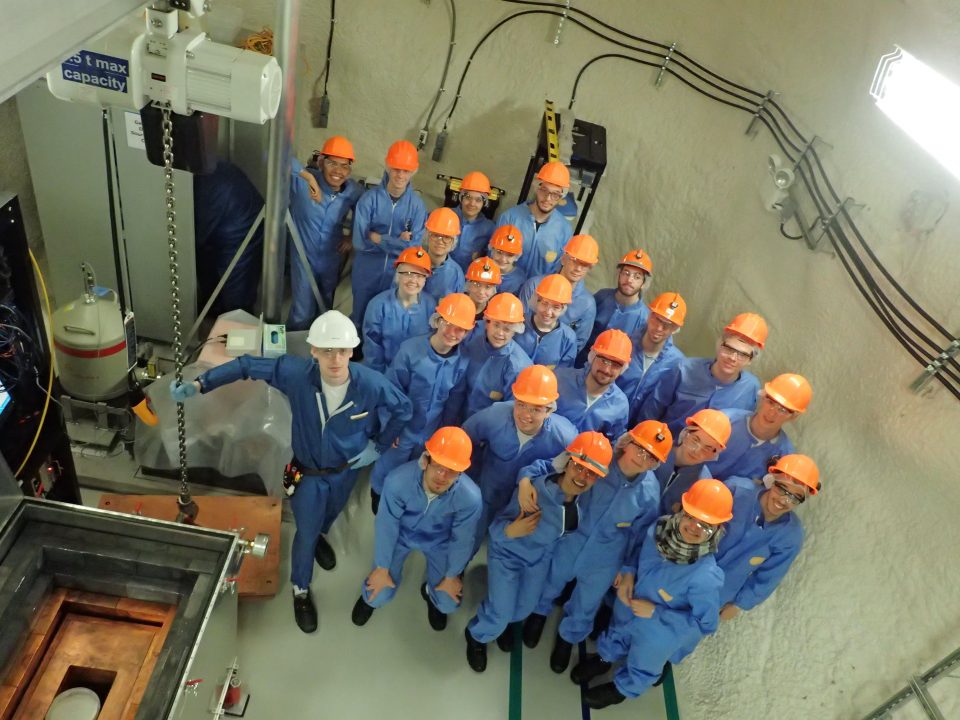
Undergraduate Summer School
The Canadian Astroparticle Physics Summer School will return this year May 10 – 16th, 2020. For more info, please see:
mcdonaldinstitute.ca/capss-info
Undergraduate Summer Positions
SNOLAB Group Summer Student Employment
APPLICATION DEADLINE: Friday, February 7th, 2020
The Experimental Particle Astrophysics Group at Queen’s University has openings for undergraduate summer researchers in summer 2020. The group is actively involved in the design, construction, and operation of next-generation experiments that seek to answer fundamental questions in particle physics and astrophysics, including searches for dark matter particles (PICO, DEAP, NEWS, SuperCDMS), studies of solar and geo-neutrinos, and neutrinoless double-beta decay (SNO+, MAJORANA), and investigations into advanced detector technologies (see www.sno.phy.queensu.ca/group/). Much of the experimental work takes place at SNOLAB, a world-leading, ultra-low background particle astrophysics laboratory located 6800’ underground in Vale’s Creighton mine, near Sudbury (see www.snolab.ca). Some of the summer research activities could take place at SNOLAB. Successful candidates will have strong academic records in Physics, Engineering Physics, Chemistry, or a related discipline and will have some relevant experience demonstrating the potential for research. Students eligible for NSERC USRA or other fellowship support are strongly encouraged to apply.
The following experiments anticipate hiring one or more students this summer. Please send a cover letter, a cv and a copy of a recent transcript by e-mail to the contact for each of the experiments you are interested in. 3rd-year students interested in the Accelerated Master’s program can contact the research groups below for information about research possibilities, and apply to the Queen’s University Physics Department.
Germanium Point Contact Detector and Machine Learning Lab.
Our lab studies high-purity germanium detectors that have applications in both searches for dark matter and neutrinoless double-beta decay. We also develop machine learning algorithms to support data analysis in particle astrophysics experiments. We have recently received a very large point contact germanium detector for next-generation experiments, and are looking for students to help us model and characterize this detector, as well as to work on other projects. Opportunities are available to participate in data analysis, design, as well as for hands-on experience working with the detectors and electronics in our lab at Queen’s. Specific projects will be chosen to align with the skills that a student wishes to develop over the summer (hardware/software or both).
Contact: Ryan Martin (ryan.martin@queensu.ca)
DEAP and DarkSide are experiments using liquid argon to search for dark matter. Opportunities include data analysis on DEAP, and simulating and testing the data acquisition system for DarkSide. Contact: Philippe Di Stefano (distefan@queensu.ca)
NEWS-G has developed novel spherical gas detectors that are exceptionally sensitive to low energy interactions. A large volume spherical detector has been built and is currently being installed underground at SNOLAB to search for low-mass dark matter particles and other rare low energy interactions. Prototype detectors are currently being built and tested at the Queen’s NEWS-G lab. Summer positions are available to assist with the data taking at SNOLAB and Queen’s, with the dark matter search and calibration data analysis, and with the development and testing of novel detector technologies.
Contact: Victoria Millious (mv41@queensu.ca)
PICO searches for dark matter using bubble chambers. In these detectors, the superheated liquid undergoes phase transitions when recoiling nuclei from WIMP interactions deposit energy in the fluid. These phase transitions are detected using sensitive piezo-electric transducers and video cameras. PICO-40L is the current phase of the experiment and is currently being commissioned underground at SNOLAB. The next phase of the experiment, PICO-500, is currently in the design stage. Potential
summer positions include assisting with the detector operation, dark matter search and calibration data analysis, and design and testing of PICO-500 components.
Contact: Diana Turner (diana.turner@mcdonaldinstitute.ca)
SNO+ will study the fundamental properties of neutrinos using a 780-tonne liquid scintillator target. The experiment is currently operating at SNOLAB. Potential summer research activities include data analysis, assisting in the preparation of calibration systems and calibration sources, participating in the development of tellurium process systems and procedures, and operating the detector during data taking.
Contact: Alex Wright (awright@queensu.ca)
The IceCube and P-ONE experiments are looking for neutrino interactions in the Antarctic Ice and in the water off the coast of Vancouver, respectively. The experiments are in different operational phases, with IceCube taking data and P-ONE working on the preliminary design. Students could be involved with simulations and data analysis on either or both projects while working toward gaining an understanding of the calibration potential of P-ONE.
Contact: Ken Clark (kjc5@queensu.ca)
The McDonald Institute has two undergraduate jobs available for the summer of 2020, made available through the Summer Work Experience Program (SWEP). The first is a Research & Education/Outreach role working with a faculty member and the Education and Outreach Officer. The second is a Student Finance and Budget Assistant working with the Finance Officer.