
News & Events
March 23, 2025
Ashwati Sanjay (UofA) on HeLIOS
University of Alberta undergraduate Ashwati Sanjay knew she wanted to pursue graduate studies but working side by side with PhD candidate Marvin Hirschel, who has years of experience with the Helium ultraLIght Optomechanical Sensor (HeLIOS), and Dr. John P. Davis, Physics Professor and co-founder of Zero Point Cryogenics, finally solidified the desire to pursue this research for the rest of her life.
Sanjay’s work built on the previous research done by undergraduate student, Noah P. Baker, who characterized and described a novel method of vibration isolation in a cryogen-free dilution refrigerator. This is done through a coupled mass-spring setup, where the method for damping also functions as a thermal link, allowing heat to leave the detector below.
Sanjay in particular studied “different materials and their properties to isolate the best one. [I] ran simulations looking into the behaviour of the cantilever springs attached to the mass and optimised the geometry for our setup, conducted experiments characterizing the resulting damping and determined how much improvement was gained with the vibration isolation apparatus.”
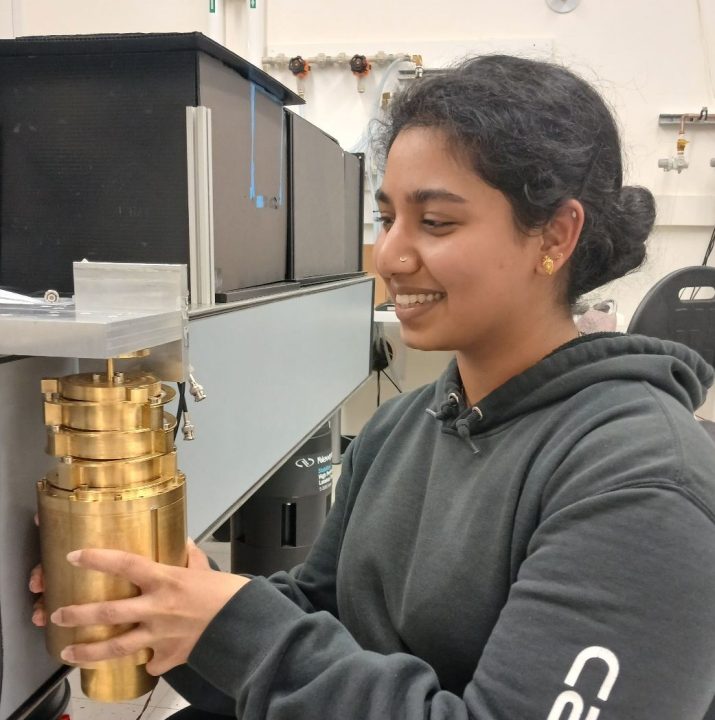
HeLIOS was Sanjay’s first research project, and as for many other young researchers, adjusting to a new environment with new people was a challenge, but with the support and “excellent guidance” of her supervisor, Sanjay settled into an “amazing environment to learn and work on my research skills.”
It wasn’t all easy going – when the experiment ran into issues, Sanjay tried a number of adjustments that didn’t cleanly resolve the problem. With the guidance of her supervisor she was able to take different approaches, ultimately overcoming the issues and collecting good data. When reflecting on the difficult parts of the project, Sanjay felt it “made me more tenacious in both my research pursuits as well as class work to keep trying, change up ideas, and ask for help when needed because eventually everything will work out.”
The project also allowed Sanjay to explore her interests, one being machining, which was new to her and which she hopes to incorporate into future work. She also enjoyed the variety that doing experimental work offers, by getting to “read papers, look into the theory, run simulations, and conduct experiments” which contributed to the excitement of getting to participate in cutting-edge research.
The experience also provided an opportunity to connect with many new people and get insight into the large variety of potential industry work available after completing graduate studies. There are many options for graduating students and having opportunities to work on larger projects during their undergrad can help develop their skillset and expose them to the many possibilities in the public and private sector. This was true for Sanjay as she knew that she wanted to pursue a career in research and getting to work on the project gave her the “direction for where and how I want to achieve it and the skills to back it up.”