
3D Printed Models Gallery
Accessible Representations of Astronomical Data Through Touch
Tactile galaxy lithophanes are designed to transform astronomical data into physical forms that can be explored both visually and through touch. While telescope images and digital visualizations remain essential tools in astronomy, lithophanes provide an additional way for learners to engage with these datasets by translating them into textured, multi-panel models. This approach allows learners to physically explore how astronomers interpret and compare different types of observational data.
Developed as part of the McDonald Institute’s Physics in Three Dimensions initiative, these models combine optical and radio data products, and braille labelling into a single tactile format. By presenting multiple representations of the same galaxy side by side, lithophanes allow learners to compare datasets, trace structural patterns, and interpret brightness variations through both visual and tactile interactions. In classrooms, outreach programs, and museum environments, this approach supports conceptual understanding while expanding accessibility in astronomy education.
Why Tactile Galaxy Models Matter
Educational Challenges in Physics
Astronomy is a science that is often communicated through visual imagery. Observations from telescopes are typically presented as photographs, maps, and digital visualizations that reveal structure across vast cosmic scales. While these representations are powerful scientific tools, they can present challenges in educational settings where learners are asked to interpret three-dimensional structures from two-dimensional images.
For many students, understanding the spatial structure of galaxies requires translating flat images into mental models of shape, scale, and orientation, a process that relies on strong visual interpretation skills. As a result, learners may struggle to fully grasp how astronomers interpret observational data and develop an understanding of the three-dimensional structure of galaxies.
These challenges can also create barriers in inclusive learning environments. When astronomical information is presented primarily through visual imagery, learners who benefit from tactile exploration or who have limited access to visual representations may encounter additional obstacles when engaging with astronomy concepts.
The Role of Lithophanes in Astronomy Learning
Lithophanes provide a way to engage with astronomical data by translating images into tactile surfaces that can be explored through both touch and sight. By converting differences in brightness into variations in thickness, these models allow learners to physically trace patterns and identify structures within astronomical images, supporting a more interactive approach to data interpretation.
When designed with multiple panels, lithophanes also enable direct comparison between different types of observations. This allows learners to explore how each dataset represents different properties of the same galaxy. This side-by-side format helps reinforce how astronomers use multiple observations to build a more complete understanding of galaxy behavior.
For educators, lithophanes provide a structured tool for introducing how astronomical data is collected and interpreted. Learners can explore each panel through touch, compare patterns across datasets, and connect these representations to the physical properties they describe. By supporting both visual and tactile interaction, lithophanes offer an accessible and engaging way to investigate how galaxies are studied in modern astronomy.
Educational Benefits
Lithophanes provide a structured way to engage with astronomical data by presenting multiple observational views of the same galaxy in a single, tactile format.
In classroom and outreach environments, this multi-panel design supports discussion around how astronomers use different types of observations to study galaxies. Learners can explore each panel through touch, identify patterns across datasets, and connect these representations to the underlying physical properties of the galaxy. This approach encourages active engagement with the data while supporting a range of learning styles.
Because lithophanes can be experienced both visually and tactually, they also support inclusive learning environments. When combined with braille labels and tactile orientation markers, the models provide an accessible pathway for learners who are blind or have low vision while remaining fully usable for sighted learners. These models can be used alongside telescope images or classroom datasets to support activities focused on comparing observations and identifying patterns in astronomical data.
Galaxy Lithophanes
What is a Lithophane?
A lithophane is a three-dimensional print created from an image in which variations in material thickness correspond to differences in brightness in the original picture. Brighter regions of the image are printed thinner, while darker regions are printed thicker, producing subtle variations in surface height across the model. These variations create a textured surface that can be explored through touch, allowing patterns in the image to be physically traced with the hands. As a result, structures that would normally be interpreted visually can also be identified through tactile exploration.
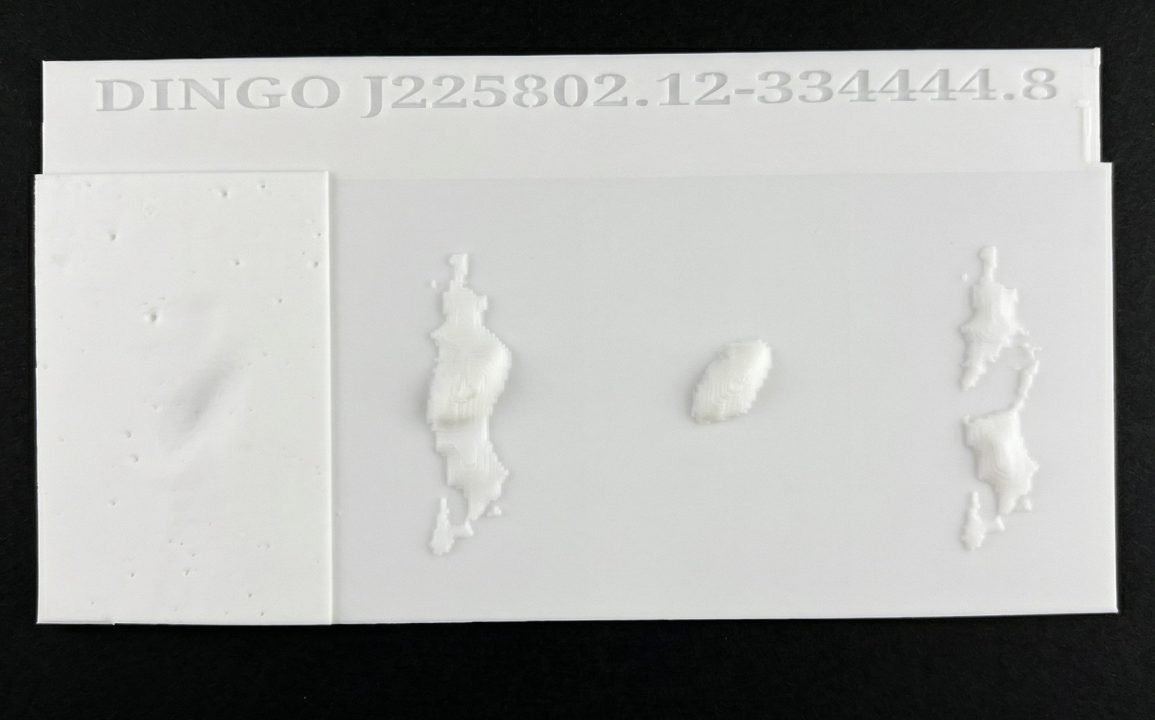
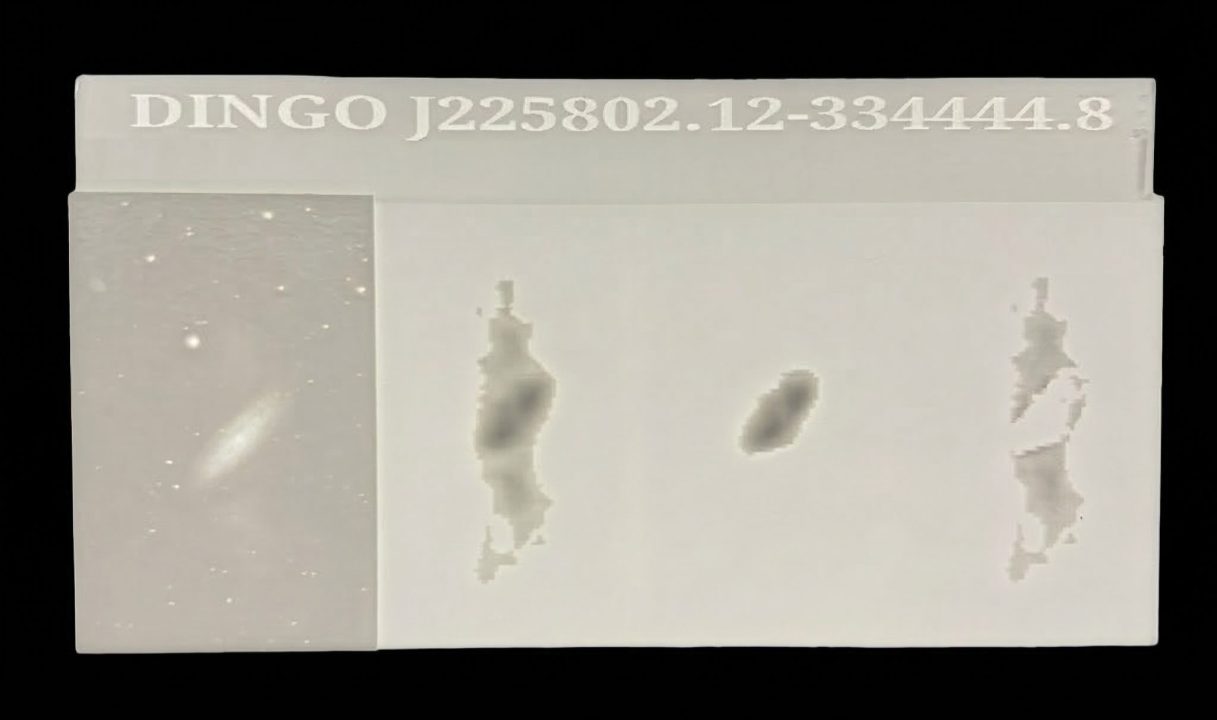
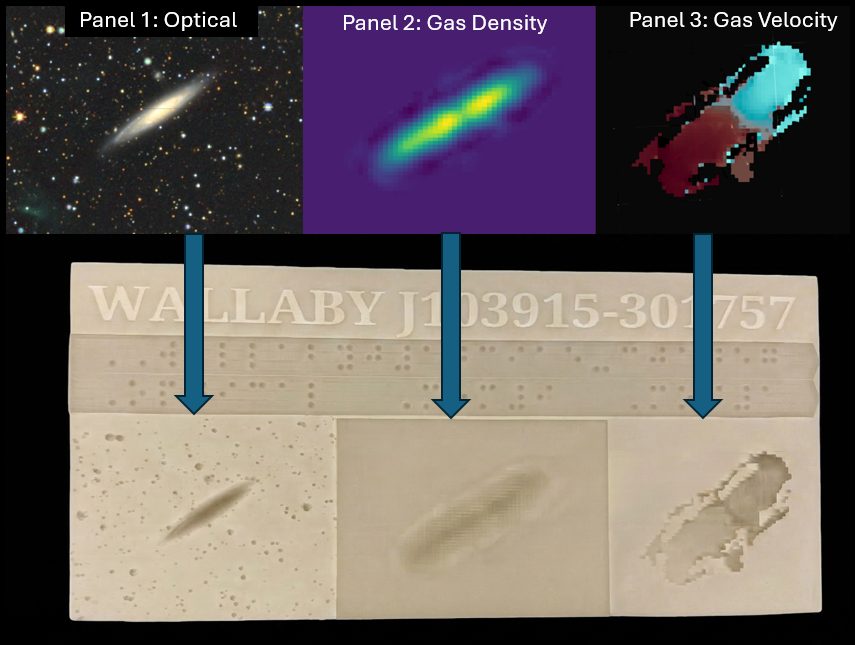
In this project, lithophanes are used to represent multiple observational views of the same galaxy. Each model includes panels showing an optical image alongside radio survey data products the distribution of hydrogen gas (middle panel), and the velocity structure within the galaxy (right panel). The variations in brightness present in each dataset are translated into small height differences across the surface of the print, allowing learners to feel changes in structure as they move their fingers across the model. This tactile representation helps users identify features such as spiral patterns, regions of gas concentration, and gradients in velocity information.
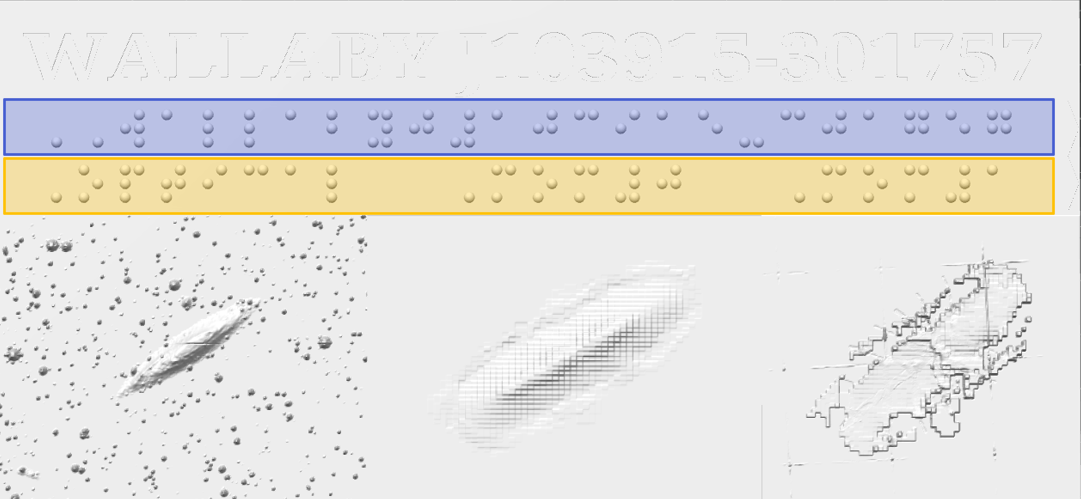
Braille labels are incorporated to identify the galaxy name and to mark the optical, distribution, and velocity panels. These labels provide orientation and context, enabling learners who rely on tactile reading to navigate the model independently. By combining tactile surface structure with braille labeling, the lithophane models allow learners to compare multiple astronomical datasets while engaging with the information through both visual and tactile exploration.
Astronomical Image Conversion
Creating a galaxy lithophane begins with astronomical images obtained from telescope observations or survey data. The brightness values of each image are mapped to variations in material thickness, where brighter regions are printed thinner and darker regions are printed thicker. This process produces a surface with subtle height variations that reflect the structure present in the original data.
The resulting model transforms flat astronomical images into tactile surfaces that can be explored through touch. As learners move their fingers across the model, they can detect changes in brightness, identify structural patterns, and compare features across different datasets. While the models can also be illuminated to reveal the image visually, their primary strength lies in providing a tactile way to interpret and compare astronomical data.
Accessibility Features
Braille Integration
Braille labelling is incorporated into many of the tactile galaxy models to provide orientation and descriptive information for learners who are blind or have low vision. Labels identify key structural features, such as the galaxy core, spiral arms, or orientation markers, that help users understand the model’s layout. By integrating Braille directly into the printed surface or by providing tactile legends, the models allow users to independently interpret the structure being represented.
These labels are designed to complement rather than replace visual elements. Sighted learners can observe the galaxy structure through illumination and surface contours, while braille readers can access the same information through touch. This dual-mode approach allows the models to function effectively in mixed-ability learning environments, ensuring that all learners can explore the same physical representation of astronomical data.
Tactile Surface Interpretation
In addition to braille labeling, lithophanes use subtle variations in surface height to represent differences in brightness across each dataset. These variations allow users to explore astronomical images through touch by tracing patterns and identifying changes in structure across the model.
Because each lithophane includes multiple panels, tactile features also support comparison between datasets. Learners can move between panels to feel how the same galaxy appears in optical and radio observations, reinforcing how different types of data are used to study galaxy properties. Careful attention is given to the scale and spacing of these features to ensure they remain interpretable through touch while preserving the underlying scientific information.
Future Development
The development of tactile galaxy lithophanes represents an initial step toward expanding accessible tools for engaging with astronomical data. Future work will focus on increasing the range of galaxies and datasets that can be represented, allowing learners to explore a wider variety of galaxy types and observational perspectives. This includes incorporating additional survey data and refining how multiple datasets are presented within a single 3D printed model.
Further improvements will continue to enhance the tactile and accessible design of the lithophanes. This includes refining braille labeling, improving tactile clarity across different panels, and developing consistent orientation features that support independent exploration. Ongoing iterations will also explore how surface detail and scale can be optimized to better represent subtle variations in astronomical data while remaining interpretable through touch.
In addition to model development, future work will focus on supporting educators through the creation of classroom resources and lesson materials that integrate lithophanes into astronomy education. By combining observational data with accessible design and hands-on learning, lithophanes have the potential to become a versatile tool for teaching how astronomers interpret and compare different types of data.